The Truth About Quartz Countertop Care
Most quartz countertops don’t suddenly become stained, dull, or damaged.
Manufacturers often describe quartz as maintenance-free. In real homes, field experience shows that quartz surfaces still require proper care to maintain appearance, cleanability, and long-term performance.
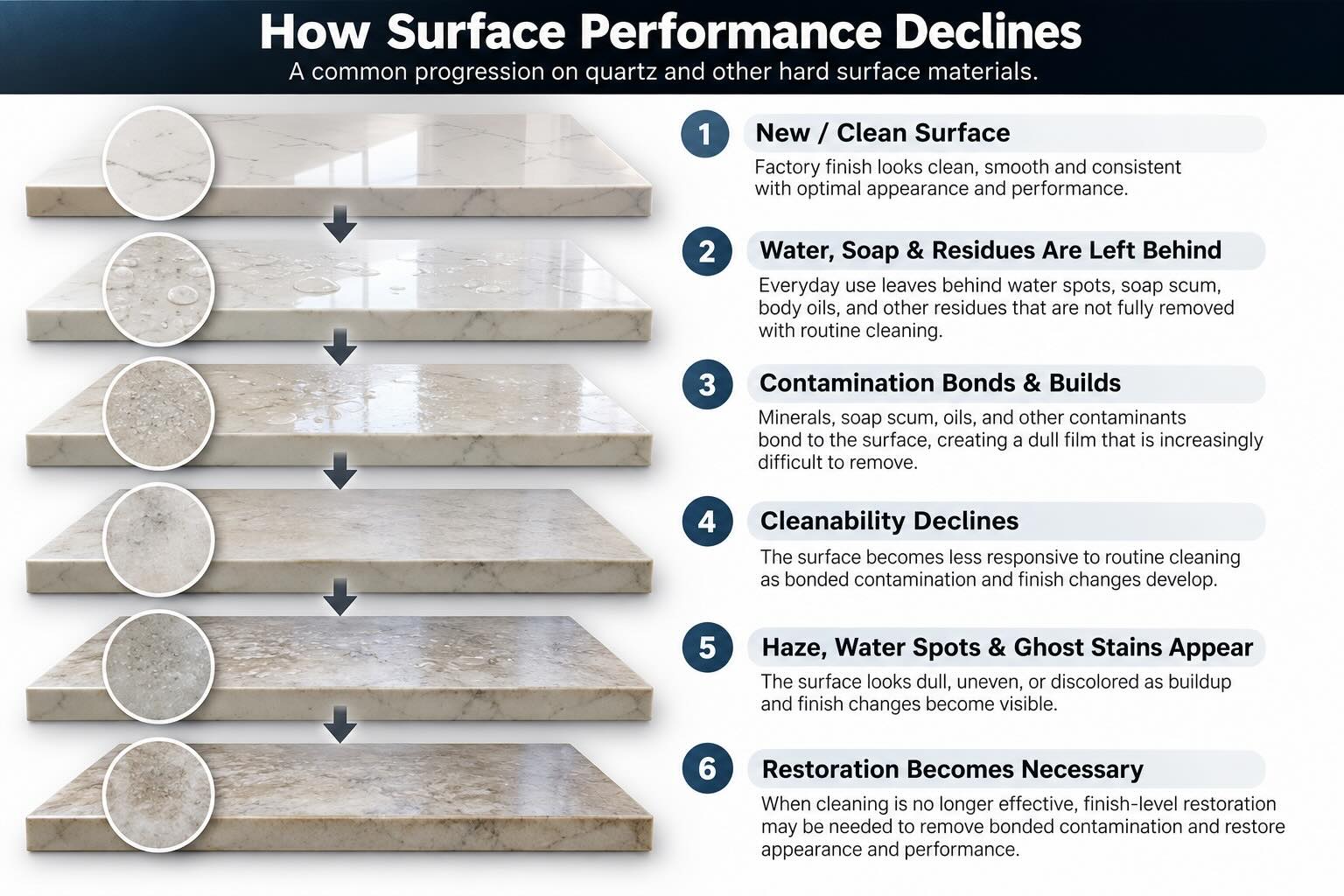
What Happens When Quartz Care Is Misunderstood
- Hard-water deposits begin forming.
- Water spotting becomes more visible.
- Soap and cleaning-product residue accumulate.
- Surfaces become harder to clean.
- Water spotting becomes more visible.
- Haze and ghost stains appear.
- Homeowners assume the surface is damaged.
What begins as a few water spots can eventually become:
- White haze
- Ghost stains
- Dull areas
- Hard-water deposits
- Discoloration
- Reduced cleanability
- Premature surface aging
One Methodology ⎯ 4 Product Solutions
Supreme Surface® Product Solutions can be used individually or combined as the building blocks for Surface Care Systems that work with your surface, not against it. Get the help you need, and no marketing hype.
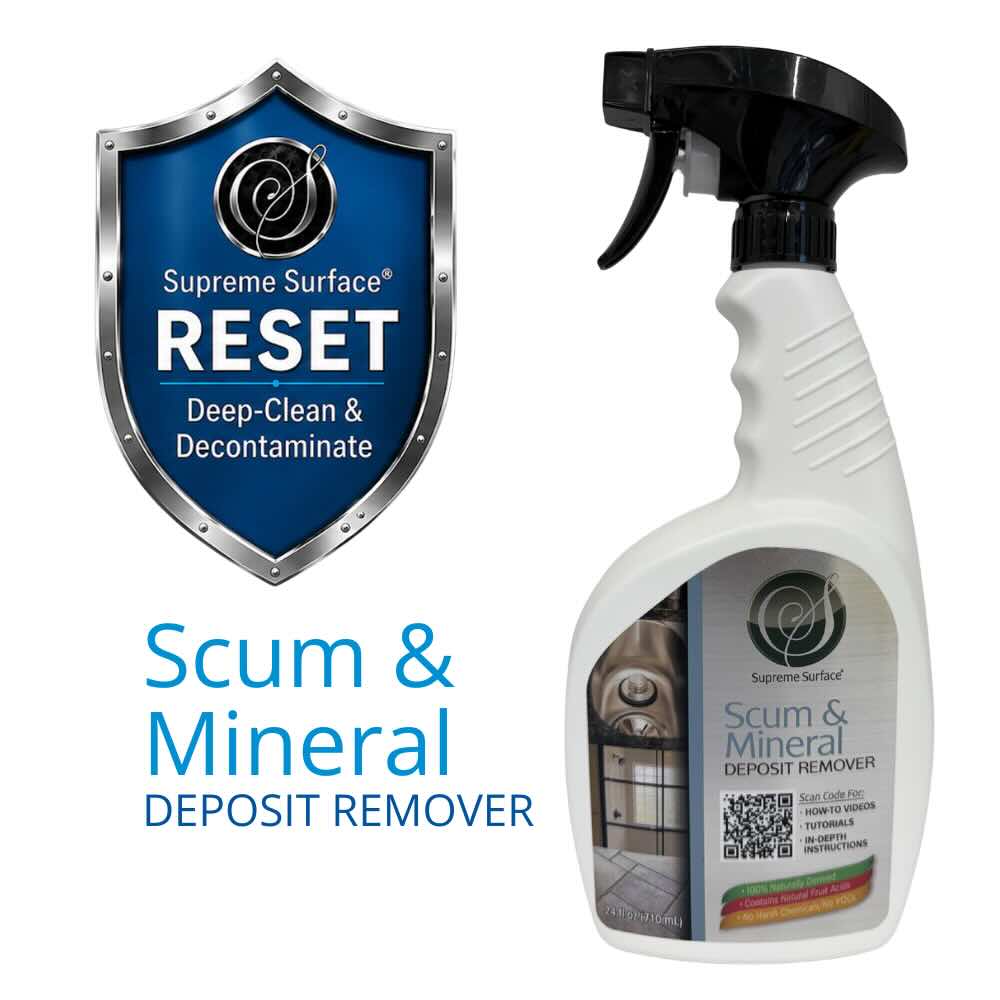
RESET
Deep-Clean &
Decontaminate
Removes contamination, hard-water solids, scum lines, oil residue, and soap buildup. Safe on quartz, granite, marble, and composite sinks.
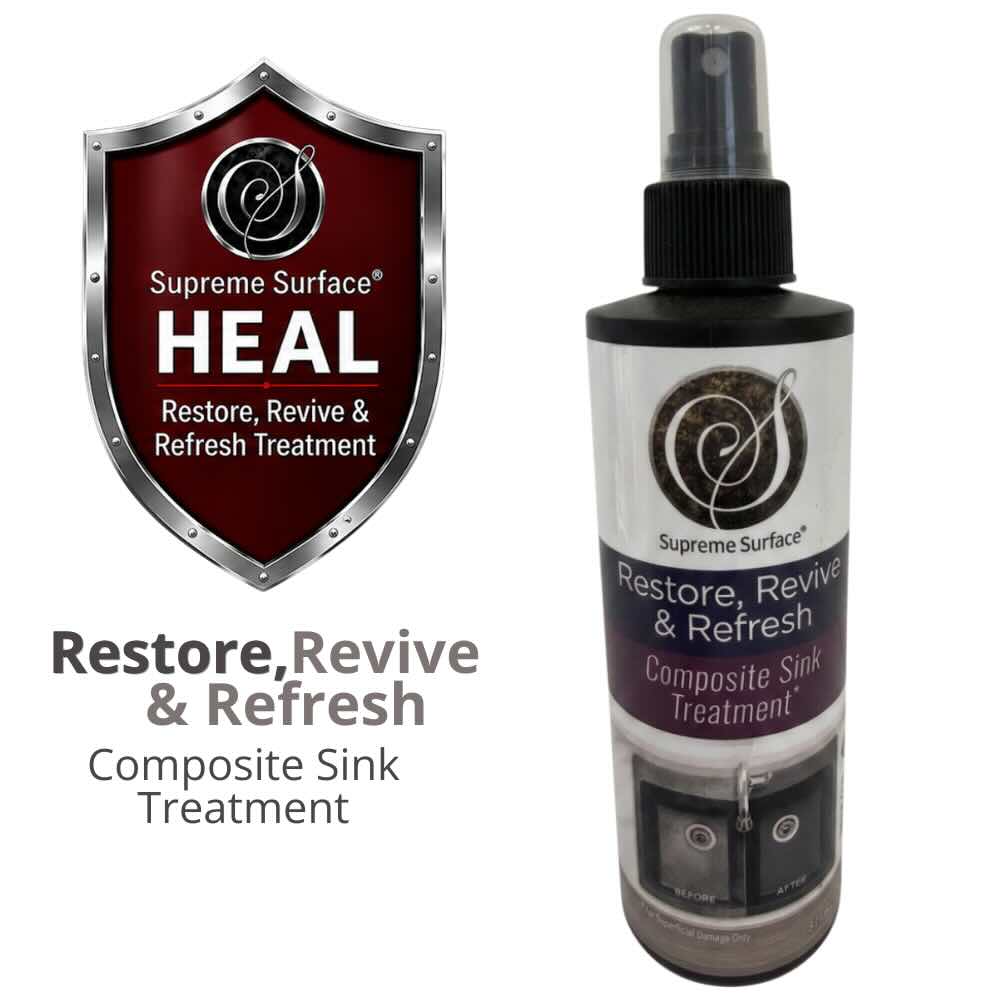
HEAL
Restore, Revive &
Refresh
A deep-seal restoration treatment for composite sinks — restoring color, reviving surface appearance, and refreshing faded or hazy finishes.
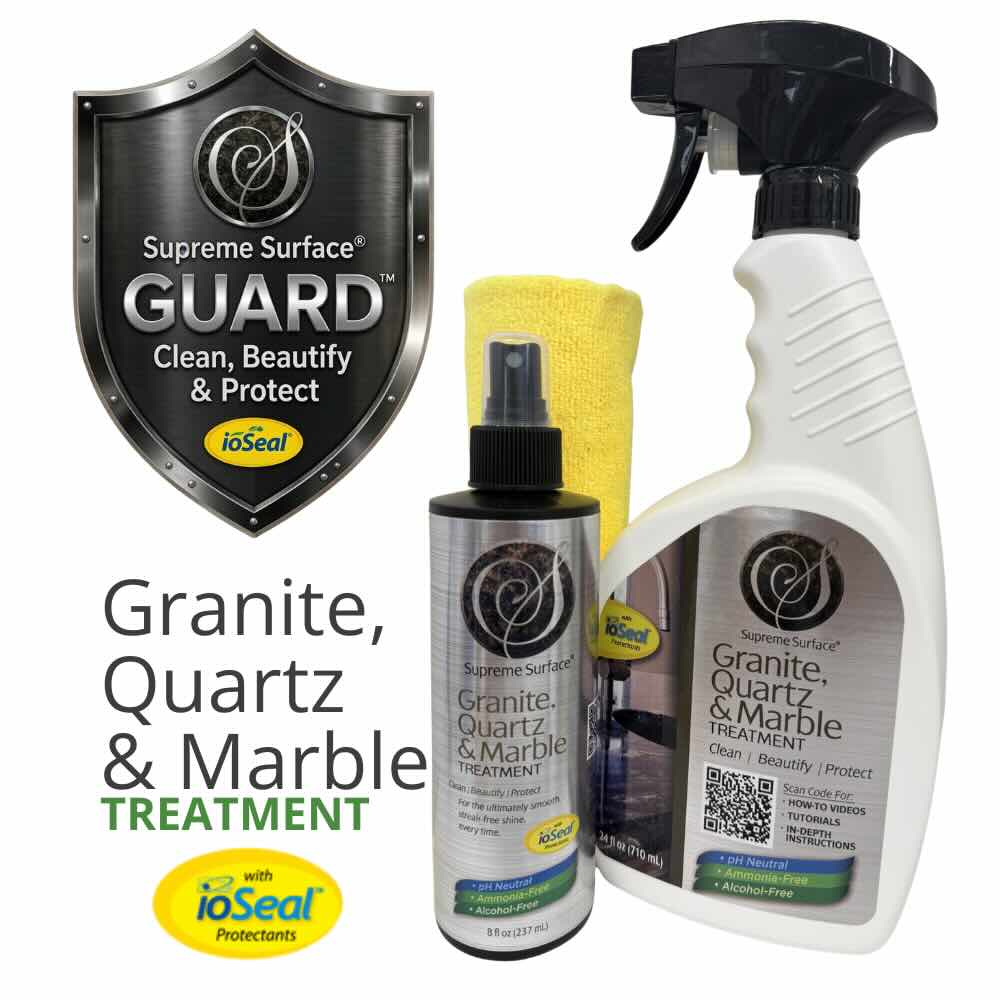
GUARD
Clean, Beautify &
Protect with ioSeal®
A one-step, one-spray clean, beautify & protect — improving cleanability, enhancing appearance, and supporting long-term ease of maintenance.
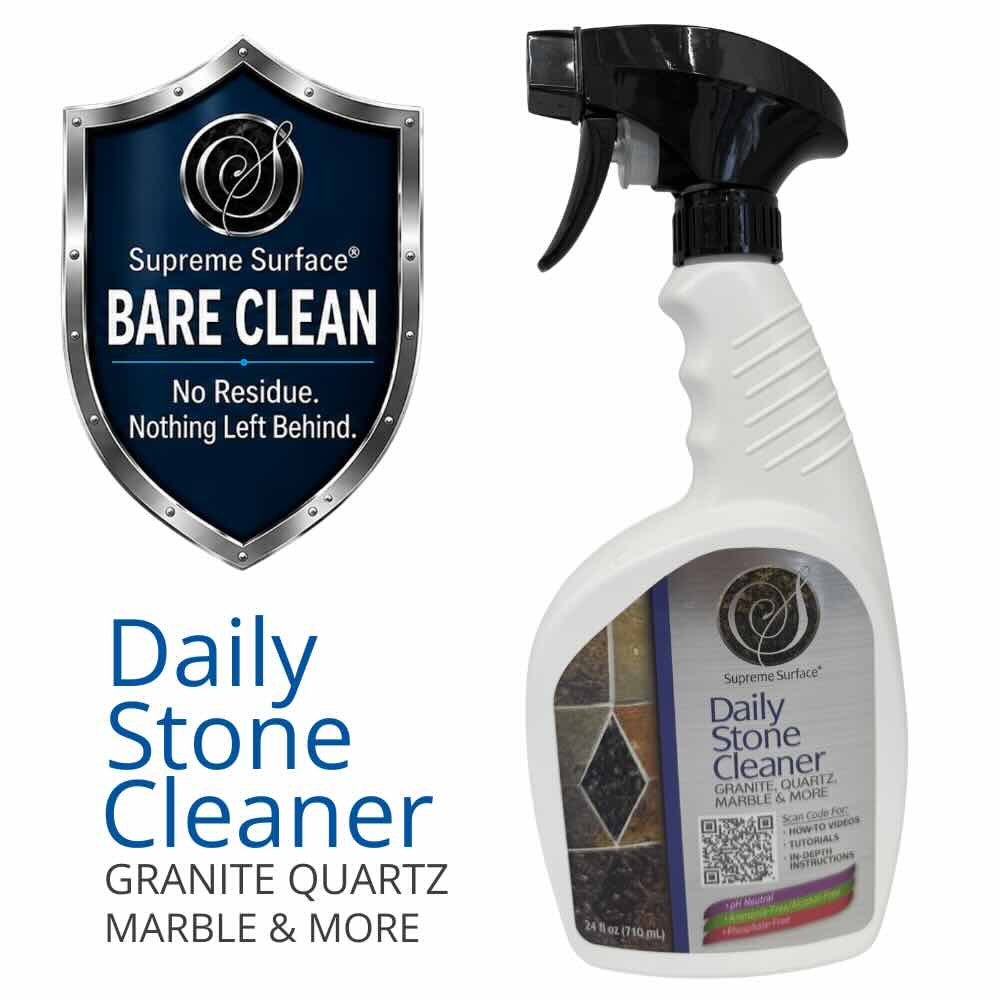
BARE CLEAN
No Residue
Nothing left behind!
pH-neutral, alcohol-free, fragrance-free, residue-free daily maintenance for granite, quartz, marble, and more — Nothing left behind!
Product Solutions Are the Building Blocks
Each Supreme Surface® Product Solution delivers standalone value — and combines into Care Systems designed around specific surfaces, conditions, and desired outcomes.
Supreme Surface® Big 3
RESET + GUARD + BARE CLEAN
The foundation of routine surface care for quartz countertops, natural stone, composite sinks, stainless steel sinks, and more — combining corrective cleaning, long-term protection, and residue-free maintenance into a simple approach designed to improve and preserve surface performance.
Quartz Routine Care System
GUARD + BARE CLEAN
For quartz countertops free of mineral deposits and bonded residue, or surfaces that have been properly decontaminated, GUARD provides ongoing cleaning, beautification and ioSeal® protection; BARE CLEAN provides residue-free daily maintenance.
If mineral, soap or bonded residue is already present, begin with RESET using shorter dwell times appropriate for quartz, then transition to GUARD + BARE CLEAN.
Composite Sink Care & Restoration System
RESET + HEAL + GUARD
From New Installations to Advanced Reconditioning
ioSeal®: Why Prevention Changes Everything
Quartz countertops are often described as nonporous and maintenance-free, but that does not prevent material from accumulating and bonding at the finish level.
Tap water can leave dissolved mineral solids behind as it evaporates. Dish soap and other cleaners can also leave residue. On an unprotected surface, these materials can progressively anchor to microscopic surface irregularities, contributing to water spots, haze, ghosting, discoloration and reduced cleanability.
ioSeal® exists to address that finish-level vulnerability.
How ioSeal® Is Different
Conventional surface protection and enhancement products generally rely on one of several approaches:
- Penetrating or impregnating porous materials
- Forming a topical coating or film
- Using oils, waxes, or other materials primarily to alter surface appearance
These approaches serve different purposes, but they do not necessarily address the finish-level conditions encountered on quartz and other resin-bound surfaces. Penetrating sealers are designed primarily for absorbent materials, while topical coatings and oil-based treatments can introduce their own maintenance requirements.
ioSeal® operates differently. Its ionic resin-bonding technology is designed to bond at the finish level, helping to fill microscopic surface irregularities and create a smoother, more maintainable surface. This allows ioSeal® to:
- Bond to mineral- and resin-based surfaces
- Help fill and smooth microscopic surface irregularities
- Reduce the ability of minerals, oils, and residues to anchor to the finish
- Provide progressive protection with continued use without forming a topical film
This allows ioSeal® to provide finish-level protection on dense and resin-bound surfaces such as quartz and composite sinks, while also complementing appropriate sealing methods used on porous natural stone.
Rather than waiting for bonded contamination and declining cleanability to require corrective treatment, ongoing ioSeal® protection helps:
- Keep the finish easier to clean and maintain
- Reduce contaminant anchoring
- Reduce recurring mineral, oil, and residue buildup
- Reduce the frequency of corrective cleaning or restoration
This is why prevention is a foundation of long-term surface performance: maintain the finish before accumulated contamination makes corrective treatment necessary.
The Role of ioSeal® in Quartz Care
ioSeal® is the protective technology delivered through GUARD. On clean or properly decontaminated quartz, it can be used directly to help protect the finish and improve ongoing surface performance.
The care path depends on the condition of the surface:
- Clean or new quartz: Begin with GUARD to establish progressive ioSeal® protection.
- Routine maintenance: Use GUARD for cleaning, beautification and protection, with BARE CLEAN for residue-free daily cleaning.
- Mineral, soap or bonded residue: Use RESET first to decontaminate the surface, then transition to GUARD + BARE CLEAN.
ioSeal® does not form a topical film or require quartz to be porous. Its resin-bonding protection works at the finish level, helping reduce contaminant anchoring while progressively improving the surface with continued use.
Bottom Line
Quartz performance problems typically develop progressively as residue, minerals, oils and other contaminants accumulate or bond at the finish level. Proper decontamination when needed, followed by ongoing ioSeal® protection and appropriate routine cleaning, helps keep the surface easier to clean and maintain over time.
Why Engineered Quartz Can Stain
(Understanding the Resin Matrix)
Engineered quartz is highly durable and generally considered nonporous, but it is not solid natural stone. It is manufactured from mineral aggregates combined with polymer resins, pigments and other materials. The exact composition varies by manufacturer and product.
Because quartz contains both mineral and resin components, its finished surface can respond differently to contamination, chemicals, heat, UV exposure and repeated cleaning. What appears to be a “stain” may involve material bonded to the finish, residue accumulation, changes within the resin-rich surface, or a combination of these conditions.
Traditional penetrating stone sealers are not designed for quartz
Penetrating and impregnating sealers are designed primarily for absorbent materials such as porous natural stone, where the treatment can enter the surface.
Engineered quartz is a dense, resin-bound material. Because it does not absorb a penetrating sealer in the same way porous stone does, these products generally do not address the finish-level conditions responsible for many quartz care problems.
The ioSeal® Difference: Rather than relying on penetration, ioSeal® uses ionic resin-bonding technology designed to bond at the finish level with mineral- and resin-based surfaces.
With continued use, it helps fill and smooth microscopic surface irregularities, reducing the ability of minerals, oils, residues and other contaminants to anchor to the finish.
Getting Started TIPS
Polished Quartz Countertops: On a clean or properly decontaminated surface, begin with GUARD for 3–5 consecutive days to establish progressive ioSeal® protection, then use weekly or more often as needed. Use BARE CLEAN for residue-free daily cleaning.
Honed, Matte & Suede Quartz Finishes: Textured and low-sheen finishes can hold fingerprints, oils, minerals and residue more readily than polished quartz. Begin with GUARD for 7–10 consecutive days to establish progressive ioSeal® protection, then continue as needed for easier routine maintenance.
If Mineral, Soap or Bonded Residue Is Already Present: Begin with RESET using the shorter dwell times appropriate for quartz. Once the surface has been properly decontaminated, transition to GUARD for protection and BARE CLEAN for routine maintenance.
Why Surfaces Look Ruined (But Aren’t)
Most visible problems on quartz countertops are not structural failures. They are often finish and performance problems that develop gradually as minerals, oils, residues, and other contaminants accumulate or bond at the surface.
Quartz is durable and structurally non-porous, but that does not mean its exposed finish remains unchanged in real-world use. Daily exposure to water, cooking oils, cleaners, heat, friction, and residue can affect how the surface looks, feels, and responds to cleaning.
This is why quartz can begin to appear:
- Shadowed or darker in certain areas
- Hazy or cloudy despite repeated cleaning
- Prone to fingerprints or smudging that won’t buff away
- Dull or uneven compared with surrounding areas
- Clean when wet, but visibly different again after drying
These symptoms can be mistaken for permanent staining or damage. Often, the first question should be whether the problem is bonded contamination or a finish-level condition rather than damage to the slab itself.
That distinction matters. When the underlying quartz is sound, the appropriate path may be decontamination with RESET, followed by ongoing protection with GUARD and residue-free routine maintenance with BARE CLEAN—rather than increasingly aggressive cleaning methods.
Common Quartz Surface Symptoms
(Often Misdiagnosed)
If you’re seeing any of the symptoms below, the quartz may not be permanently damaged. Similar-looking problems can result from bonded contamination, changes at the finish level, or actual surface damage. Identifying the condition first helps determine the appropriate care path.
Visual Failures
Ghost Stains
Dark or discolored areas that remain visible after routine cleaning. Oils, minerals, residues, or changes at the finish level can produce this appearance.
Persistent Shadowing
Uneven darkened areas that can make the surface appear dirty even after cleaning. This may result from bonded contamination, oils, minerals, or changes within the finish.
Finish Failures
Cloudy or White Haze
A dull, milky, or cloudy appearance that may result from mineral deposits, cleaner residue, bonded contamination, or changes to the surface finish.
Persistent Fingerprints
Fingerprints and smudges that reappear quickly or resist normal wiping, particularly on matte, honed, or textured quartz where oils can be more visible.
Surface Appearance Changes
Fading or Chalky Appearance
A dry, gray, faded, or whitened appearance that becomes especially noticeable as the surface dries. Cleaning alone may not correct the condition.
Premature Dulling
A reduction in the original sheen or clarity of the finish. Possible contributors include bonded mineral buildup, chemical exposure, abrasion, accumulated residue, or changes to the surface itself.
How to Choose the Right Surface Care Path
Not every surface problem requires restoration. Visible symptoms can result from bonded contamination, changes at the finish level, loss of protection, or actual surface damage. Because similar-looking conditions can have different causes, the correct approach depends on the current condition of the surface.
Use the guide below to identify the condition and choose the appropriate care path.
The Role of ioSeal® in the System
ioSeal® is not a standalone shortcut. It is most effective when applied:
- After proper decontamination with RESET
- After finish restoration with HEAL, when required
Once in place, ioSeal® — delivered through GUARD — maintains surface performance between cleanings and protects against the conditions that caused failure in the first place.
This is not about making surfaces shine. It is about maintaining functional performance in environments that are anything but controlled.
If Your Surface Looks Dirty, Shadowed, or Hazy — But Color Is Still Intact
These symptoms may indicate bonded contamination or residue at the finish level and should generally be evaluated through cleaning and decontamination before assuming the surface is permanently damaged.
Common signs:
- Water spots or mineral haze that won’t wipe away
- Shadowing or dark areas where oils have contacted the surface
- Fingerprints that immediately reappear after cleaning
Recommended Path:
RESET → GUARD
Decontaminate the surface to remove bonded residues, then restore ongoing protection to prevent re-anchoring.
If the Surface Looks Faded, Chalky, or Uneven When Dry
These symptoms may indicate a depleted or compromised finish, particularly on composite sinks or other resin-bound surfaces.
Common signs:
- Surface appears gray, white, or dull when dry
- Color deepens temporarily when wet, then fades again
- Texture feels dry or uneven
Recommended Path:
RESET → HEAL → GUARD
Finish-level restoration may be required before ongoing protection can be effective.
If the Surface Has Been Sanded, Etched, or Mechanically Altered
Mechanical abrasion, sanding, or chemical damage can permanently alter a factory quartz finish. Once the original finish has been physically changed, routine cleaning or protective treatment alone may not restore the original appearance.
Recommended Path:
First determine whether the condition is bonded contamination or an actual alteration of the surface finish.
If contamination remains, properly decontaminate the surface before applying ongoing protection. If the factory finish itself has been mechanically or chemically altered, professional refinishing or repair may be required.
GUARD with ioSeal® can help protect a properly prepared finish, but it is not intended to recreate a factory finish that has been physically removed or damaged.
If the Surface Is New or Currently Performing Well
Prevention is the most effective strategy.
Recommended Path:
GUARD + BARE CLEAN
Use GUARD to establish and maintain progressive ioSeal® protection, with BARE CLEAN as the residue-free daily cleaner between GUARD applications.
If You’re Unsure
When symptoms overlap or conditions are unclear, start conservatively.
Recommended Path:
Begin by determining whether bonded contamination is present. If so, use RESET to decontaminate the surface, then reevaluate the finish before moving to protection or considering additional corrective work.
Bottom Line
Surface care is not one-size-fits-all. The correct path depends on surface condition, not guesswork or trending advice. When the right steps are applied in the right order, long-term performance becomes predictable—and unnecessary restoration can often be avoided.
Frequently Asked Questions About Quartz & Stone Surface Care
Why does my quartz look cloudy, dull, or shadowed even after cleaning?
Cloudiness, dullness, or shadowing on quartz can result from mineral deposits, cleaner residue, oils, bonded contamination, or changes at the finish level. These conditions can look similar to permanent staining or damage, even when the underlying quartz is still intact.
If routine cleaning does not correct the appearance, the surface condition should be identified before stronger cleaners or abrasive methods are used. Bonded contamination may require proper decontamination before ongoing protection and routine maintenance can be effective.
Do quartz countertops need sealing?
Yes—but not with a traditional penetrating stone sealer.
Engineered quartz is dense and resin-bound, so traditional penetrating and impregnating sealers are not designed for the way quartz performs. Quartz still requires finish-level protection to help resist mineral, oil, residue, and contaminant bonding during real-world use.
This is where ioSeal® Ionic Technology is different. Rather than relying on penetration, ioSeal® uses ionic resin-bonding technology designed to bond at the finish level with both mineral- and resin-based surfaces. With continued use, it helps fill and smooth microscopic surface irregularities, improving resistance to contaminant bonding and making the surface easier to clean and maintain.
So, does quartz need sealing? Yes. It needs a sealer designed for quartz—not a traditional penetrating stone sealer.
Why did dish soap, vinegar, or ‘non-scratch’ pads make my surface worse?
Dish soap, vinegar, and abrasive cleaning pads are often recommended as general household cleaning solutions, but repeated use can create problems on quartz and other finished surfaces.
• Dish soap can leave surfactant residue behind when it is repeatedly used without thorough rinsing, contributing to film, streaking, and contaminant buildup.
• Vinegar and other household acids may attack mineral deposits, but uncontrolled acidity and repeated exposure can affect some surface finishes, resins, sealers, and surrounding materials. Purpose-formulated mineral removal provides better control.
• “Non-scratch” pads and melamine sponges can still be abrasive. Repeated scrubbing may alter sheen or texture, particularly on polished, honed, matte, or resin-rich surfaces.
Over time, improper cleaning methods can contribute to residue buildup, finish changes, or loss of protection—making the surface increasingly difficult to maintain.
Why don’t manufacturers cover dulling, haze, or stains under warranty?
Because a warranty and real-world surface performance are not aligned.
Quartz is commonly marketed as durable, nonporous, stain resistant, and low maintenance. But warranty coverage is defined by specific terms and exclusions—not simply by whether the surface continues to look and perform as the consumer expected.
When haze, dulling, persistent staining, mineral buildup, discoloration, or other appearance problems develop, the surface may be performing poorly while the condition is still classified as maintenance-, use-, or exposure-related rather than a covered manufacturing defect.
The surface can have a real performance problem without having a warrantable manufacturing defect.
That is why proper diagnosis matters. The question is not simply whether the condition is covered under warranty, but what changed at the surface and what can be done about it.
Is dulling or haze permanent?
In many cases, no. What appears permanent is often bonded contamination or a change at the finish level, not material failure. When correctly identified, the surface can often be reset, repaired if necessary, and protected to restore performance without replacement.
Why does mineral oil make sinks and countertops look worse over time?
Mineral oil can temporarily make a faded or chalky surface look darker because it wets the surface and masks the underlying condition. It does not repair the finish or provide lasting protection.
With repeated use, oil can leave residue, create an uneven appearance, and collect soils and other contaminants at the surface. As the oil wears or washes away, the original fading, haze, or chalky appearance returns—often leading to repeated applications without correcting the underlying problem.
If a surface looks dramatically better when wet or oiled but fades again when dry, that is an important diagnostic clue: treat the condition of the surface rather than continually masking it with oil.
What’s the difference between cleaning, restoration, and prevention?
- Cleaning removes loose soil and everyday surface contamination.
- Restoration corrects an existing finish or performance problem when cleaning alone is no longer enough.
- Prevention protects the surface to reduce contaminant bonding, finish degradation, and the need for future restoration.
Long-term surface performance depends on prevention—not repeated restoration.
How do I know which surface care approach I need?
The correct approach depends on the condition of the surface, not material type alone.
• If the color is intact but residue, haze, or shadowing won’t clean away, decontamination followed by protection may be sufficient.
• If the surface looks chalky, faded, or uneven when dry—but the color returns when wet—finish-level restoration may be needed before protection.
A diagnostic approach helps avoid unnecessary abrasion, aggressive cleaning, and over-treatment.